GLOSSIA AI Smart Glasses Review – Stylish Open-Ear Audio Glasses with AI Translation Features
“This link will take you to Amazon.”
Smart wearable technology continues to evolve beyond traditional smartwatches and earbuds, and smart glasses are becoming one of the most interesting categories in personal tech. Combining audio, communication, and hands-free convenience into a stylish wearable design, smart glasses aim to make daily life more connected without constantly looking at a phone.
The GLOSSIA AI Smart Glasses combine Bluetooth audio, open-ear listening, AI-powered translation tools, touch controls, and voice assistant support into a lightweight eyewear design suitable for both casual and professional use.
Unlike bulky headsets or traditional earbuds, these glasses use open-ear directional audio technology, allowing users to listen to music, take calls, and interact with voice assistants while still remaining aware of their surroundings.
With multilingual translation support, hands-free controls, and compatibility with both Android and iOS devices, the GLOSSIA AI Smart Glasses are positioned as a versatile wearable for travel, work, communication, and everyday convenience.
In this detailed review, we will explore the design, comfort, sound quality, AI features, battery life, usability, strengths, weaknesses, and overall value of the GLOSSIA AI Smart Glasses to help you determine whether they are worth adding to your tech collection.
Introduction
Wearable technology has shifted from purely fitness-focused devices toward more lifestyle-oriented products. Smart glasses are part of this transition, offering discreet access to audio, communication, and smart features without covering the ears completely or requiring constant phone interaction.
The GLOSSIA AI Smart Glasses focus on three major areas:
- Open-ear audio
- AI translation support
- Hands-free convenience
These glasses are designed for users who want:
- Music while staying aware of surroundings
- Convenient hands-free calls
- Travel-friendly translation assistance
- Stylish everyday wearable tech
The inclusion of Bluetooth connectivity and touch-sensitive controls further enhances the user experience, making the glasses practical for commuting, outdoor walking, office work, and casual use.
Their semi-rimless design also helps them resemble ordinary fashion eyewear more closely than some oversized smart glasses competitors.
Key Features
1. Open-Ear Directional Audio Technology
The glasses use open-ear audio technology to deliver sound toward the user’s ears without blocking surrounding environmental noise.
This allows users to:
- Listen to music
- Hear navigation prompts
- Take calls
- Stay aware of traffic and surroundings
This feature is particularly useful for outdoor activities and commuting.
2. Built-In Microphones for Calls
Integrated microphones allow users to make and receive phone calls directly through the glasses.
The microphones are designed to provide:
- Clear voice pickup
- Hands-free communication
- Convenient calling during movement
3. AI Translation Features
One of the standout features is multilingual AI translation support through the companion app.
The glasses support:
- Voice conversation translation
- Simultaneous interpretation
- Text translation
This functionality may be useful for:
- International travel
- Language learning
- Business communication
- Cross-language conversations
4. Touch Controls
The touch-sensitive temple controls allow users to:
- Play or pause music
- Answer or reject calls
- Activate voice assistants
- Control audio playback
This reduces the need to constantly handle a smartphone.
5. Lightweight Semi-Rimless Design
The glasses feature:
- Lightweight construction
- Ergonomic fit
- Semi-rimless modern styling
The design aims to balance comfort and appearance for everyday wear.
6. Bluetooth Connectivity
The glasses support Bluetooth pairing with:
- Android devices
- iPhones
- Tablets
- Other Bluetooth-enabled devices
Wireless connectivity allows fast and convenient setup.
Pros and Cons
Pros
- Open-ear audio improves awareness
- Stylish lightweight design
- Hands-free calling support
- AI translation features add versatility
- Comfortable for extended wear
- Easy Bluetooth pairing
- Convenient touch controls
- Compatible with Android and iOS
- Useful for commuting and travel
- Voice assistant support included
Cons
- Audio privacy may be limited in very quiet environments
- Translation performance depends on app quality and internet connection
- Battery life may vary depending on usage
- No built-in display or augmented reality features
- Sound quality may not match premium headphones
Detailed Review
Design and Appearance
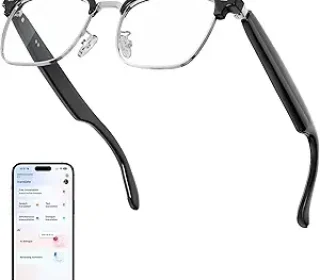
One of the strongest aspects of the GLOSSIA AI Smart Glasses is their stylish appearance.
Unlike some smart glasses that look bulky or overly futuristic, the GLOSSIA model uses a more subtle semi-rimless design that resembles regular fashion eyewear.
The black frame and lightweight construction help the glasses feel modern without drawing excessive attention.
This makes them suitable for:
- Office environments
- Casual daily wear
- Travel
- Outdoor activities
- Business settings
The lightweight frame also improves long-term comfort during extended use.
Users who dislike heavy wearable devices will likely appreciate the ergonomic fit.
Comfort and Everyday Wearability
Comfort is critical for smart glasses because users may wear them for several hours at a time.
The lightweight design helps reduce:
- Nose pressure
- Ear fatigue
- General discomfort
The open-ear audio approach also avoids the discomfort some users experience with in-ear earbuds during long listening sessions.
Because the ears remain uncovered, users can naturally hear:
- Conversations
- Traffic
- Environmental sounds
This creates a more natural listening experience, especially during walking or commuting.
The glasses are particularly practical for users who want background audio without feeling completely isolated from their surroundings.
Audio Performance
The open-ear directional audio system is designed to send sound toward the ears while minimizing sound leakage.
This technology works well for:
- Podcasts
- Phone calls
- Navigation prompts
- Casual music listening
One major advantage is environmental awareness. Unlike noise-isolating headphones, users remain aware of:
- Cars
- People
- Public announcements
- Outdoor surroundings
This improves safety during:
- Walking
- Cycling
- Commuting
However, open-ear audio systems usually cannot match the deep bass or immersive sound quality of premium over-ear headphones.
In louder environments, users may also need to increase volume levels.
For casual everyday listening and convenience, though, the performance is solid.
Call Quality and Microphones
The built-in microphones perform an important role in hands-free communication.
The glasses allow users to:
- Answer calls quickly
- Speak without holding a phone
- Continue walking or working during conversations
The microphone clarity is generally suitable for:
- Everyday calls
- Voice assistant commands
- Short meetings
- Travel communication
This hands-free convenience becomes especially useful during multitasking situations.
AI Translation Features
The translation capability is one of the product’s most interesting features.
Through the companion app, users can access:
- Voice translation
- Simultaneous interpretation
- Text translation
This may be useful for:
- Travelers
- International business users
- Language learners
For example, users can potentially communicate across language barriers more naturally without constantly typing into a phone.
However, translation accuracy and responsiveness depend heavily on:
- The companion app
- Software updates
- Internet connection quality
- Supported languages
The feature is best viewed as a helpful communication tool rather than a perfect real-time interpreter.
Still, for travel and basic multilingual assistance, it adds meaningful versatility.
Touch Controls and Smart Features
The touch-sensitive side controls improve convenience significantly.
Users can:
- Pause music
- Skip tracks
- Answer calls
- Activate voice assistants
without touching their smartphone.
This is especially helpful during:
- Exercise
- Driving breaks
- Walking
- Commuting
- Travel
The controls are intuitive and reduce distractions caused by constant phone handling.
Voice assistant support also enhances hands-free functionality for:
- Navigation
- Messages
- Reminders
- Quick information searches
Battery Life and Charging
The glasses feature a rechargeable lithium-ion battery with 100mAh capacity.
Battery performance depends on:
- Music volume
- Call frequency
- Translation usage
- Bluetooth activity
For moderate daily use, the battery is generally designed to last through much of the day before requiring recharging.
Users relying heavily on continuous audio playback or translation features may experience shorter runtime.
Still, for casual everyday wearable use, battery life appears practical.
Connectivity and Compatibility
Bluetooth pairing is straightforward with both:
- Android devices
- iPhones
The wireless connection process is simple and typically takes only a few moments.
Stable connectivity is important for:
- Audio playback
- Calls
- Translation functions
- Voice assistant integration
The glasses also eliminate the hassle of carrying separate earbuds for casual listening and communication.
Real-World Use Cases
The GLOSSIA AI Smart Glasses are especially useful for:
Commuters
Listen to audio while remaining aware of surroundings.
Travelers
Translation tools may assist during international trips.
Office Users
Hands-free calls and notifications improve convenience.
Outdoor Walkers
Open-ear listening improves environmental awareness.
Language Learners
Translation support adds educational value.
Casual Tech Enthusiasts
Provides wearable smart functionality without bulky equipment.
Who Should Buy This Product?
The GLOSSIA AI Smart Glasses are ideal for:
Travelers
The AI translation features can help during communication abroad.
People Who Dislike Earbuds
Open-ear audio provides a more comfortable alternative.
Commuters and Walkers
Environmental awareness improves safety outdoors.
Professionals
Hands-free calls and smart controls improve productivity.
Tech Enthusiasts
Interesting wearable gadget with multiple practical functions.
Casual Audio Listeners
Convenient for podcasts, calls, and light music listening.
Comparison with Similar Products
GLOSSIA vs Traditional Bluetooth Earbuds
GLOSSIA Advantages
- Open-ear awareness
- More comfortable for long wear
- Stylish wearable design
- Built-in translation features
Earbuds Advantages
- Better audio immersion
- Stronger bass
- More private listening
The GLOSSIA glasses prioritize convenience and awareness over maximum audio performance.
GLOSSIA vs Premium Smart Glasses
GLOSSIA Advantages
- Simpler interface
- Lightweight design
- More affordable category
- Focused feature set
Premium Smart Glasses Advantages
- Advanced AR features
- Integrated displays
- Higher-end audio systems
The GLOSSIA model focuses more on practical daily wearable functionality.
Frequently Asked Questions
Do the glasses work with iPhone and Android?
Yes, they support Bluetooth connectivity for both iOS and Android devices.
Can other people hear the audio?
Open-ear audio minimizes leakage, but very high volume levels may still be audible in quiet spaces.
Are the glasses suitable for outdoor use?
Yes, the open-ear design improves awareness during outdoor walking and commuting.
Do the glasses include augmented reality displays?
No, these glasses focus on audio, calls, translation, and smart controls rather than AR visuals.
How are calls handled?
Built-in microphones and Bluetooth connectivity allow hands-free calling directly through the glasses.
Is the translation feature automatic?
Translation features work through the companion app and supported modes.
Are they comfortable for long-term wear?
Yes, the lightweight ergonomic design is intended for all-day comfort.
Final Verdict
The GLOSSIA AI Smart Glasses offer an impressive combination of wearable convenience, open-ear audio, hands-free communication, and AI translation support in a stylish and lightweight design.
Their ability to deliver music, calls, voice assistant access, and multilingual communication while maintaining environmental awareness makes them particularly useful for commuting, travel, and everyday multitasking.
The semi-rimless appearance also helps the glasses blend naturally into both casual and professional settings without looking overly futuristic.
While the audio quality may not fully replace premium headphones and translation accuracy depends on the companion software, the overall functionality and convenience provide strong value for users interested in practical smart wearable technology.
If you are looking for lightweight smart glasses that combine Bluetooth audio, translation support, stylish design, and hands-free convenience, the GLOSSIA AI Smart Glasses are definitely worth considering.
Affiliate Disclaimer
This article may contain affiliate links. If you purchase through these links, we may earn a small commission at no additional cost to you. This helps support our content and allows us to continue creating honest and helpful product reviews.