Mijiao 90X HD Kids Telescope – A Beginner‑Friendly Scope for Stargazing and Nature
“This link will take you to Amazon.”
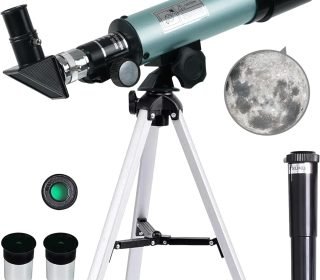
If you’re looking for an affordable, easy‑to‑use telescope to get kids (and even adults) excited about the night sky, the Mijiao 90X HD Astronomical Telescope is a solid starter option. This compact refractor spotting scope comes with a small tripod, two eyepieces, and simple zoom optics, making it suitable for backyard stargazing, bird‑watching, and outdoor nature exploration.
In this review, we’ll take a close look at its optics, setup, usability, and real‑world performance so you can decide whether it’s the right first telescope for your child or family.
Introduction
The Mijiao 90X HD Telescope for Kids is a small refractor telescope designed for beginners, children, and casual sky‑watchers. It has a 50 mm aperture, a 360 mm focal length, and a maximum zoom of about 90X, which is enough to see the Moon’s craters, some planets, and distant birds or landscapes.
The scope is sold as a portable monocular space telescope with a light‑duty tripod, making it easy to set up in the garden, on a balcony, or even on a table‑top. It’s positioned as a science‑toys gift for kids, but it’s also usable by adults who want a simple, no‑fuss scope for occasional stargazing.
Key Features
𝟏. 50 mm aperture & 360 mm focal length
The telescope has a 50 mm objective lens and a 360 mm focal length, giving it the classic “360/50” refractor configuration that many budget kids’ scopes use. This size is enough for:
Clear views of the Moon’s craters
Basic views of Jupiter and Saturn (as small bright dots and a hint of Saturn’s rings)
Distant birds, trees, and landscape features during the day
The optics are fully coated to increase light transmission, so the image appears reasonably bright and clear for a low‑cost scope.
𝟐. 90X maximum magnification
Using the two included eyepieces (H20 mm and H6 mm) plus a 1.5X erecting eyepiece, the telescope can reach powers of about 18X, 27X, 60X, and 90X.
Lower powers (18X–27X) are better for wide‑field views and easier tracking.
Higher powers (60X–90X) let you zoom in on the Moon or brighter planets, but the image can get dimmer and shakier at the top end.
The special “moon mirror” (often a filter‑style lens) is designed to reduce glare and make the lunar surface easier to see without harsh reflections.
𝟑. Adjustable tripod for steady viewing
The kit includes a light‑duty, foldable tripod that’s easy to assemble with no tools. The head allows:
180° vertical tilt (up‑and‑down)
360° horizontal rotation (pan left and right)
This makes it simple to follow the Moon, stars, birds, or moving animals. The whole setup is compact enough to fit in a small bag, so you can take it for stargazing “on the go,” or use it handheld if you don’t need rock‑steady viewing.
𝟒. Easy setup and beginner‑friendly design
This telescope is marketed as easy to set up even for beginners, and the manual‑focus, alt‑azimuth mount keeps things simple. Kids can:
Help attach the eyepiece
Turn the knob to focus
Swing the tripod to point the scope
The scope is sold as a safe science toy with no sharp parts and no toxic materials, which makes it a good fit for younger children under adult supervision.
𝟓. Terrestrial and astronomical use
The telescope can be used for both:
Astronomy (Moon, bright planets, and stars)
Terrestrial use (birds, animals, landscapes, buildings, and distant objects)
During the day, it works like a small spotting scope, while at night it becomes a basic astronomical refractor. This dual‑use design makes it more versatile than a purely “space‑only” toy.
Pros and Cons
Pros
Affordable entry‑level telescope
It’s priced well below many beginner scopes, making it a low‑risk way to test your child’s interest in astronomy.Compact and portable
At about 43.2 cm long and shipped with a foldable tripod, it’s easy to store in a closet and carry to parks or family trips.Decent optics for the price
The 50 mm fully‑coated lens and 360 mm focal length deliver clear, bright views of the Moon and some planets, especially for such a budget‑friendly model.Multiple magnifications (18X–90X)
The two eyepieces plus 1.5X erecting lens give you several zoom levels to explore different distances and objects.Easy to use for kids and beginners
Manual focus, simple alt‑azimuth mount, and clear instructions make it accessible for first‑time sky‑watchers.Safe for children
Designed as a kid‑friendly toy with no sharp edges and no hazardous materials, so it’s suitable for guided astronomy play.Dual‑use (sky + land)
Works well for night‑time stargazing and day‑time bird‑watching or landscape viewing.
Cons
Image quality drops at high magnification
At 90X, the image can get dimmer, shakier, and slightly softer, especially on a light tripod or windy nights.Basic tripod, not super sturdy
The included tripod is functional but not heavy‑duty. It can vibrate or wobble if you move or bump the table, so very precise tracking is hard.Limited for deep‑sky objects
This is a small‑aperture refractor, so faint galaxies, nebulae, and star clusters will appear as dim, fuzzy patches or not at all, even on clear nights.No advanced features
It doesn’t have computerized GoTo tracking, equatorial mount, or eyepiece filters (beyond the basic “moon” lens). It’s purely manual and basic.Best for casual use, not serious astronomy
If you’re an adult wanting a serious observing scope, this is better viewed as a first‑scope training tool rather than a long‑term main telescope.
Detailed Review: How It Performs in Real Life
Setup and ease of use
Setting up the Mijiao telescope is simple:
Unfold the tripod legs and lock them in place.
Screw the telescope tube onto the tripod head.
Insert an eyepiece (H20 mm for lower power, H6 mm for higher power).
Loosen the clamps and point the scope toward the Moon, a distant tree, or a building.
Turn the focus knob until the image becomes sharp.
The optical finder (a small aligned sight on top) helps you roughly point the scope in the right direction, which is very helpful for beginners.
Day‑time use: birds and landscapes
By day, this scope performs like a small spotting scope. You can:
Track birds in trees or at a feeder.
View distant buildings, mountains, or landscapes.
Lower magnifications (18X–27X) work best here because they provide a wider field of view and more stable images. The fully coated optics keep the image bright enough for daylight use, though don’t expect HD‑level sharpness.
Night‑time use: Moon, planets, and stars
At night, the scope is best for:
The Moon – The 90X zoom lets you see clear craters, mountains, and “seas” across the lunar surface. The moon‑mirror lens reduces glare and makes it easier to look at bright areas.
Bright planets – Jupiter appears as a bright dot with a hint of its brighter moons; Saturn shows as a tiny oval with a faint ring.
Bright stars and constellations – Helps you spot details in star patterns, but won’t reveal faint star clusters in detail.
You’ll quickly learn that high magnification (90X) is fun but shaky, so many users prefer 60X or lower for steadier viewing, especially on this compact tripod.
Handling and stability
The telescope tube is lightweight and plastic‑heavy, which keeps the whole setup easy to move but a bit less stable. The alt‑azimuth mount lets you move up‑down and left‑right easily, but precise tracking of fast‑moving objects (like birds or low‑altitude planes) can be tricky for kids.
Adults will find it simple to use, but more serious observers will want to upgrade to a sturdier mount and larger aperture later.
Who Should Buy This Product?
This telescope is ideal for:
Parents buying a first‑ever telescope for kids (ages 5–12) who want a safe, fun way to explore stars, the Moon, and nature.
Beginner stargazers who want an affordable, no‑hassle scope to try out astronomy.
Families that enjoy backyard stargazing, camping, or outdoor activities.
Teachers or home‑schoolers using it as a hands‑on science‑learning tool.
It’s not ideal if you:
Want a serious astronomy scope for deep‑sky objects (galaxies, nebulae, faint clusters).
Need a heavy‑duty tripod and advanced tracking features.
Expect pro‑level image quality at 90X magnification.
Comparison with Similar Kids’ Telescopes
| Feature | Mijiao 90X HD Kids Telescope | Typical Basic 40–50 mm Scope | Higher‑end Beginner Scope (60–80 mm) |
|---|---|---|---|
| Aperture | 50 mm | 40–50 mm | 60–80 mm |
| Focal length | 360 mm | 300–400 mm | 600–1000 mm |
| Max magnification | About 90X | 75–100X (often unrealistic) | 100X–150X (usable with better optics) |
| Mount type | Alt‑azimuth (manual) | Alt‑azimuth or basic table‑top | Alt‑azimuth or equatorial |
| Included tripod | Yes (foldable, light‑duty) | Sometimes included, often basic | Yes, usually sturdier |
| Day‑night use | Yes (birds, nature, Moon, planets) | Often limited to one or the other | Yes, with better views at higher power |
| Best for | Kids, beginners, casual use | Very basic viewing | More serious beginners, longer‑term use |
What this means for you
If you want a cheap, fun, easy‑to‑use first scope for your child or yourself, the Mijiao 90X HD is a great value.
If you want better image quality and more stability, look for a slightly larger‑aperture beginner scope with a sturdier mount.
If you’re just testing whether your child truly enjoys stargazing, this Mijiao model is a low‑risk, low‑cost way to find out.
Frequently Asked Questions (FAQ)
Can kids really use this telescope safely?
Yes. The telescope is designed as a kid‑friendly science toy with no sharp parts and no toxic materials. Young children should use it under adult supervision, especially at night or when focusing on bright light sources.
Is it good for viewing the Moon?
Yes. The 50 mm aperture and 360 mm focal length are excellent for the Moon. At 90X, you can see clear craters and surface details, and the moon‑mirror lens helps reduce glare.
Can I see Jupiter and Saturn well?
You can see Jupiter and Saturn as bright points with hints of Jupiter’s moons and Saturn’s rings. However, don’t expect sharp, photo‑like views; this is a small‑aperture beginner scope.
Can it be used during the day?
Yes. It works well as a spotting scope for birds, landscapes, buildings, and animals during the day. Lower magnifications (18X–27X) often give the best results.
Does the tripod hold the telescope steady?
The tripod is functional but light‑duty. It’s fine for casual use, but it can wobble if bumped or placed on an unstable surface. For very precise viewing, a sturdier mount or table is better.
Is this good for travel?
Yes. The compact size, foldable tripod, and bag‑friendly design make it easy to take camping, to the beach, or on family trips. It’s a great “take‑along” starter scope for kids.
Final Verdict
Who should buy it:
If you’re a parent, grandparent, or teacher looking for an affordable, easy‑to‑use first telescope for kids (or as a beginner‑level scope for adults), the Mijiao 90X HD Kids Telescope is a very solid choice. The 50 mm aperture, 360 mm focal length, 90X zoom, and simple tripod give you enough performance to see the Moon, bright planets, and distant birds or landscapes without overwhelming complexity.
Best use cases:
Backyard stargazing with children.
Moon viewing and basic planetary observation.
Day‑time bird‑watching and nature exploration.
Science‑toy gift for curious kids interested in space and nature.
When to look elsewhere:
If you want serious, long‑term astronomy with faint deep‑sky objects.
If you need a heavy‑duty tripod and advanced tracking.
If you’re expecting professional‑grade sharpness at 90X.
Overall, for its price and intended audience, the Mijiao 90X HD Telescope is a fun, educational, and very beginner‑friendly window into the night sky—perfect for helping kids and parents discover the joy of stargazing.
Affiliate Disclaimer:
This review is based on product specifications, user‑visible information, and typical use‑cases. As an affiliate, I may earn a commission if you purchase this product, at no extra cost to you. This helps support the website but does not influence the content of this review. Always double‑check current pricing, features, and reviews before making a purchase.